
It's the question that creates the most anxiety in the rental application process: Is my credit score good enough?
The short answer: there's no single number that gets you in or keeps you out. But there are ranges that matter, and Tyler's market works differently than Austin, Dallas, or Houston. Here's what actually happens when you apply — and what you can do if your score isn't where you want it to be.
What Tyler Landlords Typically Look For
Nationally, most landlords look for a minimum credit score between 620 and 650. In Tyler — where the rental market is less competitive than major metros — the threshold tends to be slightly more flexible, particularly with smaller properties and private landlords.
Sources: Zumper – Credit Score Requirements 2026 (https://www.zumper.com/blog/credit-score-requirements-renting/) | Apartment List – Credit Score Needed (https://www.apartmentlist.com/renter-life/credit-score-needed-to-rent-apartment) | Rent With Clara – Texas Credit Requirements (https://www.rentwithclara.com/post/texas-landlord-credit-score-requirements)
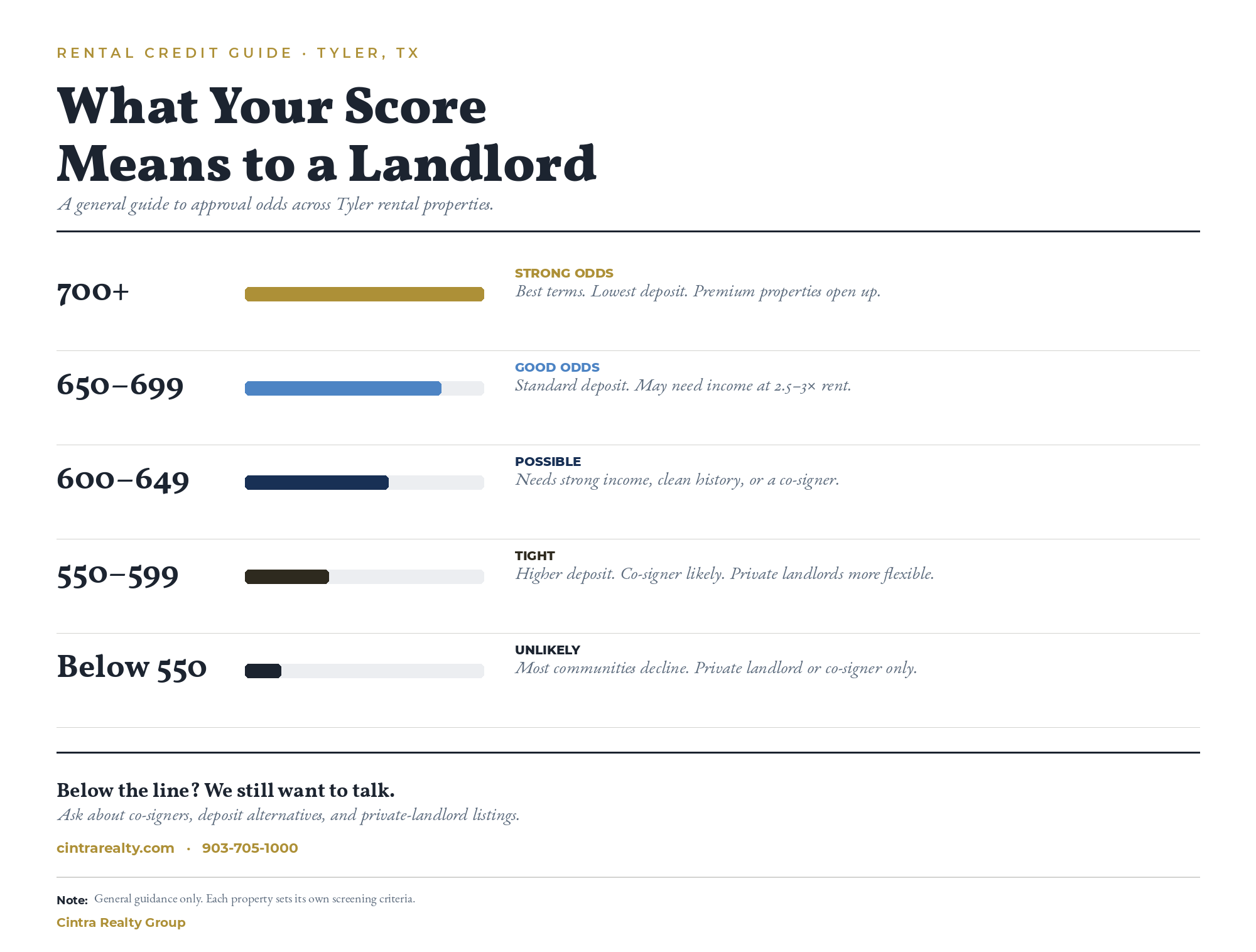
These are general guidelines. Every property and management company sets its own criteria.
Your Credit Score Isn't the Whole Story
Here's something most credit-score articles don't tell you: in 2026, more property managers are looking at the full picture, not just the number.
At Cintra, when we screen an applicant, we're looking at several factors together:
Income-to-rent ratio. Most Tyler landlords want to see gross monthly income at 2.5–3× the monthly rent. If you earn $4,000/month and the rent is $1,300, that ratio works. Strong income can offset a lower credit score.
Rental history. A clean rental record — on-time payments, no evictions, positive references from prior landlords — carries significant weight. A tenant with a 620 credit score and three years of perfect rental history is often a stronger applicant than someone with a 700 score and no rental track record.
Employment stability. How long you've been at your current job, and how consistent your income is. Healthcare workers, government employees, and remote professionals with documented employer relationships tend to screen well in Tyler's market.
Eviction history. This is the biggest red flag — more than the credit score itself. An eviction on your record within the past 3–5 years will make most Tyler landlords hesitant, regardless of your score.
Collections and derogatory marks. Medical collections are viewed differently than credit card defaults. A single medical collection from three years ago is different from a pattern of unpaid accounts. Context matters.
Source: LeaseRunner – Credit Score for Apartments 2026 (https://www.leaserunner.com/blog/what-credit-score-is-needed-to-rent-an-apartment) | TurboTenant – Rental Credit Checks (https://www.turbotenant.com/rental-screening/how-to-pass-a-rental-credit-check/)
7 Things You Can Do If Your Score Is Low
1. Check your credit report before applying. Pull your free report from AnnualCreditReport.com. Look for errors — incorrect accounts, wrong balances, accounts that aren't yours. Disputing errors can improve your score before you apply.
2. Be upfront about your situation. A brief, honest letter explaining the circumstances behind a low score (medical emergency, job loss, divorce) can make a difference — especially with property managers who review applications personally rather than through automated systems.
3. Offer a larger security deposit. Some Tyler landlords will accept a higher upfront deposit in exchange for flexibility on credit. If you can put down an extra month's rent, say so in your application.
4. Bring a co-signer. A co-signer with strong credit (typically 680+) and sufficient income adds a layer of financial security that can get you approved. Parents, family members, or trusted contacts can serve this role. The co-signer is legally responsible for rent if you don't pay, so this is a serious commitment.
5. Show strong income documentation. Pay stubs, offer letters, bank statements showing consistent deposits — anything that demonstrates your ability to pay rent on time, month after month. If your income-to-rent ratio is 3× or higher, lead with that.
6. Provide rental references. A written reference from a previous landlord confirming on-time payment and good tenancy can carry real weight. If you've been a good tenant somewhere else, make sure the new landlord knows it.
7. Look at private landlords and single-family rentals. Large apartment communities often use automated screening with hard score cutoffs. Private landlords and professional management companies like Cintra can review your application holistically — weighing the full picture rather than filtering on a single number.
What Happens During Cintra's Screening Process
When you apply to a Cintra-managed property, here's what we review:
→ Credit report (soft or hard inquiry depending on the property)
→ Income verification (pay stubs, offer letter, or bank statements)
→ Rental history and landlord references
→ Criminal background check
→ Eviction history search
→ Identity verification
We look at the full application — not just one data point. A lower score with strong income and clean rental history gets a different evaluation than a lower score with evictions and collections. Context matters, and we review every application with that in mind.
Under the Texas Property Code (§92.3515), landlords must disclose their selection criteria — including the factors that affect approval — to applicants. And under the Fair Credit Reporting Act, if an application is denied based on credit information, the landlord must provide an adverse action notice explaining the decision.
Sources: iPropertyManagement – Texas Landlord Tenant Rights (https://ipropertymanagement.com/laws/texas-landlord-tenant-rights) | Rent With Clara – Texas Credit Requirements (https://www.rentwithclara.com/post/texas-landlord-credit-score-requirements)
The Bottom Line
A perfect credit score is not required to rent in Tyler. What is required: honesty, documentation, and a willingness to present your full financial picture. Tyler's market is less competitive than the major metros, and property managers here — particularly those managing single-family homes and smaller portfolios — have more flexibility to evaluate applicants as people, not just numbers.
If you're concerned about your credit, reach out to us before you apply. We can talk through your situation and point you toward properties where your application has the strongest chance.