On June 24, 2026, Stuart Hene was sworn in as the Mayor of Tyler, succeeding Don Warren, who served since 2020. Hene won the June 13 runoff election with 57.4% of the vote, defeating former council member John Nix.
This isn't a political post. We don't endorse candidates or take sides on city council races. But a new mayor means new priorities for the city budget, development decisions, and infrastructure investment — all of which directly affect property values, rental demand, and the daily experience of living in Tyler.
Here's what Cintra is watching, and what we think renters and property owners should pay attention to.
1. The Budget Is First
Hene has been clear that his immediate priority is the 2026–2027 city budget. He'll meet with City Manager Ed Broussard and department heads to review requests and shape spending priorities before the council finalizes the budget later this year.
Why this matters for property owners: The city budget determines how much Tyler spends on streets, water, sewer, drainage, police, fire, and public facilities — the infrastructure that directly supports property values. A budget that prioritizes maintenance of existing infrastructure (not just new development) benefits current property owners across the city.
Why this matters for renters: Budget priorities flow down to the neighborhoods you live in. Better-maintained roads, faster drainage repair, improved parks, and reliable water service all affect quality of life. If you live in an area that's been waiting for attention — road resurfacing, drainage fixes, sidewalk improvements — the budget cycle is when those projects get funded or delayed.
2. South Broadway Traffic — Tyler's Most-Watched Corridor
South Broadway Avenue ranked as the 47th most congested road in Texas in 2022. Through signal re-timing under the Citywide Intelligent Transportation System Master Plan, it improved to 87th in 2023, and dropped off the top 100 entirely in 2024 (now ranked 102nd).
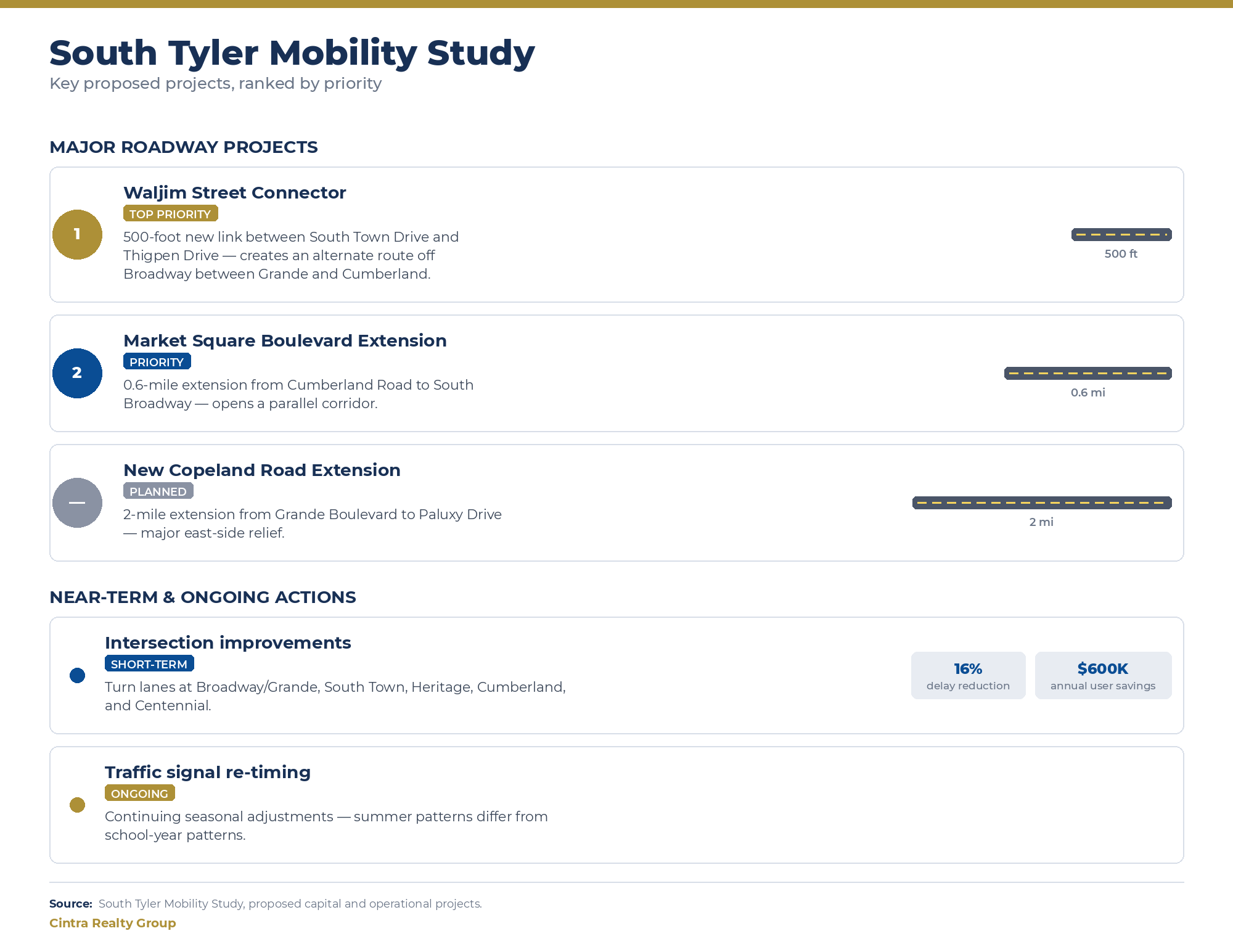
But signal timing alone can't solve a corridor where the 543-acre Bellwood development, new retail, and continued medical corridor growth are adding traffic every month. The South Tyler Mobility Study identified nine proposed projects, including:
Sources: City of Tyler – South Tyler Mobility Study (https://www.cityoftyler.org/government/departments/engineering-services/projects/south-tyler-mobility-study) | KETK – South Broadway Traffic Plan (https://www.ketk.com/news/local-news/new-plan-aims-to-ease-south-broadway-congestion-in-tyler/) | KETK – Hene Vision, June 21, 2026 (https://www.ketk.com/infocus/in-focus-tyler-mayor-elect-stuart-hene-shares-his-vision-for-citys-future/)
Hene has specifically signaled support for two approaches: extending Copeland Road south to Cumberland on the east side, and connecting Grande to Cumberland with a north-south corridor on the west side. Both would create bypass options that reduce pressure on Broadway.
Why this matters for property owners: Every infrastructure improvement along South Tyler changes the value equation for properties in the affected corridors. New road connections open up previously less-accessible areas — making them more desirable for tenants and more valuable for owners. If you own property near Cumberland, Copeland, or the Bellwood area, these projects directly affect your long-term appreciation potential.
Why this matters for renters: South Broadway congestion affects everyone who lives in southern Tyler — healthcare workers commuting to the hospitals, families driving to schools, and anyone who needs to reach Loop 323 retail. Improvements that reduce daily commute delay by even 5–10 minutes change the livability equation for these neighborhoods.
3. Water Infrastructure Gets Real Attention
During the campaign and in early interviews, Hene identified water quality and infrastructure as a priority that he shares with the entire council. The city already approved $4.2 million in emergency repairs at the Lake Palestine Water Treatment Plant in February 2026.
Why this matters: Water infrastructure isn't glamorous, but it's foundational. Aging pipes, treatment plant capacity, and sewer systems determine where new development can happen — and whether existing neighborhoods can handle population growth without service degradation. For property owners, water and sewer capacity issues can stall new construction permits, affect insurance rates, and create maintenance headaches. For renters, it affects everyday reliability.
4. Data Centers and Bitcoin Mining — A New Wild Card
Hene attended a town hall discussing a potential Bitcoin mining facility in Tyler. He's signaled that the city can take proactive measures to protect water and power resources from overuse by data centers — a growing concern statewide as Texas becomes a magnet for energy-intensive operations.
State Rep. Cody Harris has already weighed in, calling a special session on data centers premature — but the discussion is happening.
Why this matters: Large-scale data center or mining operations can strain local power grids and water supply. For Tyler — which is in a deregulated electricity market served by Oncor — any facility that significantly increases demand could affect electricity pricing and reliability for everyone. Hene's willingness to address this proactively is a positive signal for residents and property owners who remember what grid strain looked like during past Texas storms.
5. Tyler Tomorrow Implementation
Hene has explicitly aligned his campaign with the Tyler Tomorrow Comprehensive Plan, adopted March 25, 2026. His campaign platform referenced the plan directly: "Tyler already has a community-driven roadmap: the Tyler Tomorrow Comprehensive Plan, that was shaped by YOU, the voices of Tyler citizens."
His stated priorities map closely to the plan's framework:
→ Smart growth that protects Tyler's character while strengthening existing areas
→ Prioritizing streets, water, sewer, drainage, police, fire, and public facilities
→ Improving roads, connections, sidewalks, and long-term transportation
→ Protecting established neighborhoods while supporting practical housing options — including for families, seniors, workers, and young professionals
→ Supporting small businesses, quality jobs, downtown, parks, recreation, and community amenities
Why this matters: The Tyler Tomorrow plan is a document. Implementation is a series of budget decisions, zoning approvals, and infrastructure investments made over years. A mayor who actively campaigned on the plan is more likely to prioritize its recommendations than one who treats it as shelf material. For property owners and renters alike, that continuity is significant — it means the plan's promises (Midtown development, UT Tyler district improvements, North End revitalization, missing-middle housing) have political support from the top.
6. The District 1 Seat Is Now Open
Hene vacated his District 1 (Central Tyler) council seat to become mayor. That seat won't be filled until the November 2026 election. In the meantime, the council operates with one fewer member.
Why this matters: District 1 covers central Tyler — Midtown, downtown, the hospital corridor, and the areas immediately surrounding TJC. The priorities of whoever fills that seat will directly affect rental and development policy in some of Tyler's most active leasing corridors. If you own property in central Tyler, watch this race.
What Cintra Is Watching
We're not waiting for outcomes. We're tracking the signals:
→ The 2026–2027 budget process and which infrastructure projects get funded
→ Any zoning changes related to Tyler Tomorrow's "missing middle" housing recommendations
→ South Tyler Mobility Study project timelines — particularly the Waljim and Market Square connectors
→ Water infrastructure investment and how it affects development capacity in the areas we manage
→ The District 1 council race and its implications for Midtown and central Tyler policy
As a property management company operating across Tyler and 12 surrounding communities, these decisions affect our owners and tenants directly. We'll keep our clients informed as the new administration takes shape.
Learn about our property management services: https://www.cintrarealty.com/our-services/property-management/
Access the Owner Portal: https://cintra.appfolio.com/oportal
Contact us: https://www.cintrarealty.com/contact-us
Call: 903-705-1000