Every investor asks some version of the same question: is now the right time, and is this the right place?
In Tyler, the conditions in May 2026 make that question worth answering carefully. The market has shifted. Acquisition costs have softened. The tenant applicant pool is the strongest it's been in years. And single-family rentals — the product type most investors here are chasing — remain in genuinely short supply.
This isn't a post full of charts telling you what things cost. You can find that in any market report. This is about how to think about Tyler as an investment market right now — the questions that separate informed buyers from people who overpay for the wrong property in the wrong corridor.
Question 1: What Kind of Market Are We In Right Now?
Tyler is in a specific phase that matters for how you approach an acquisition:
The market is balancing. After years of bidding wars and compressed timelines, Tyler now sits at roughly 5.3 months of supply — squarely in balanced territory. Homes are going pending in about 52 days, which is actually faster than a year ago (62 days), but buyers have meaningfully more selection and negotiating room than at any point since 2021.
Home prices have softened slightly. The median sold price sits around $325,000 as of March 2026 (Redfin), with year-over-year changes showing a 1–3% decline in some segments. The median list price in May 2026 is closer to $350,000 (Movoto). Tyler remains well below the statewide Texas median (~$334K) and dramatically below Austin, Dallas, and Houston.
Mortgage rates have stabilized. The average 30-year fixed rate in Texas is approximately 6.46% as of early April 2026 (Freddie Mac), with most economists projecting a gradual drift toward the mid-6s by late 2026.
Source: Azalea Mortgage – Tyler Market Update, May 2026 (https://www.azaleamortgage.com/post/tyler-tx-housing-market-may-2026)
For a buyer, this combination is the one you want: softening acquisition costs, stabilizing rates, and more room to negotiate — while underlying demand (particularly for single-family rentals) remains firm.
Question 2: Who Will Rent From You?
This is where a lot of investors get it wrong. They buy a property, list it, and hope someone shows up. The smarter move is to buy where the tenant demand is already concentrated — and to understand who those tenants are.
Tyler's tenant pool is shaped by three forces that aren't going anywhere:
Healthcare workers. The medical corridor is Tyler's economic backbone. UT Health East Texas and CHRISTUS Trinity Mother Frances together employ over 9,500 people, and the broader healthcare sector accounts for more than 38,000 jobs in the Tyler-Longview region. Properties within a reasonable commute of these facilities — which spans neighborhoods from Southeast Tyler to Midtown to Flint — maintain high occupancy because the demand is tied to employment, not speculation. Traveling nurses and healthcare contract workers add another layer of consistent demand, particularly for furnished or short-term options near the hospital systems.
Source: Dallas Fed – Tyler-Longview (https://www.dallasfed.org/research/heart/tyler)
Families in strong school zones. School district boundaries drive rental demand in Tyler more than many investors realize. Whitehouse ISD, Bullard ISD, Lindale ISD, and Chapel Hill ISD all pull families from surrounding areas who specifically want those districts. Properties in these zones attract long-term tenants — families who stay for years, not months. One local investor recently cited a 9.2% cash-on-cash return on a $220,000 property renting for $1,850/month in a good school zone near Hollytree. These aren't flashy deals, but they're steady ones.
Source: HomeSmart Stars – Best Tyler Neighborhoods for Investment, Dec 2025 (https://www.todayseasttexas.com/blog/best-tyler-neighborhoods-investment-properties-2026/)
Remote workers relocating from DFW and other metros. Tyler sits 90 minutes from Dallas. No state income tax. Lower cost of living. Shorter commutes. These tenants want 2-bedroom minimums (home office space), quiet neighborhoods, and reliable internet. They're often earning metro salaries and paying Tyler rents — which makes them strong applicants with high income-to-rent ratios.
The key insight: these aren't transient tenant profiles. Healthcare workers on multi-year contracts, families in school zones, and settled remote workers all tend to sign longer leases and renew at higher rates. That tenant quality is what makes Tyler's rental market work — and it's specific to where in Tyler you buy.
Question 3: Where in Tyler Should You Be Looking?
Tyler isn't one market — it's a collection of micro-markets, each with a different risk-return profile. Here's how experienced local investors think about the corridors:
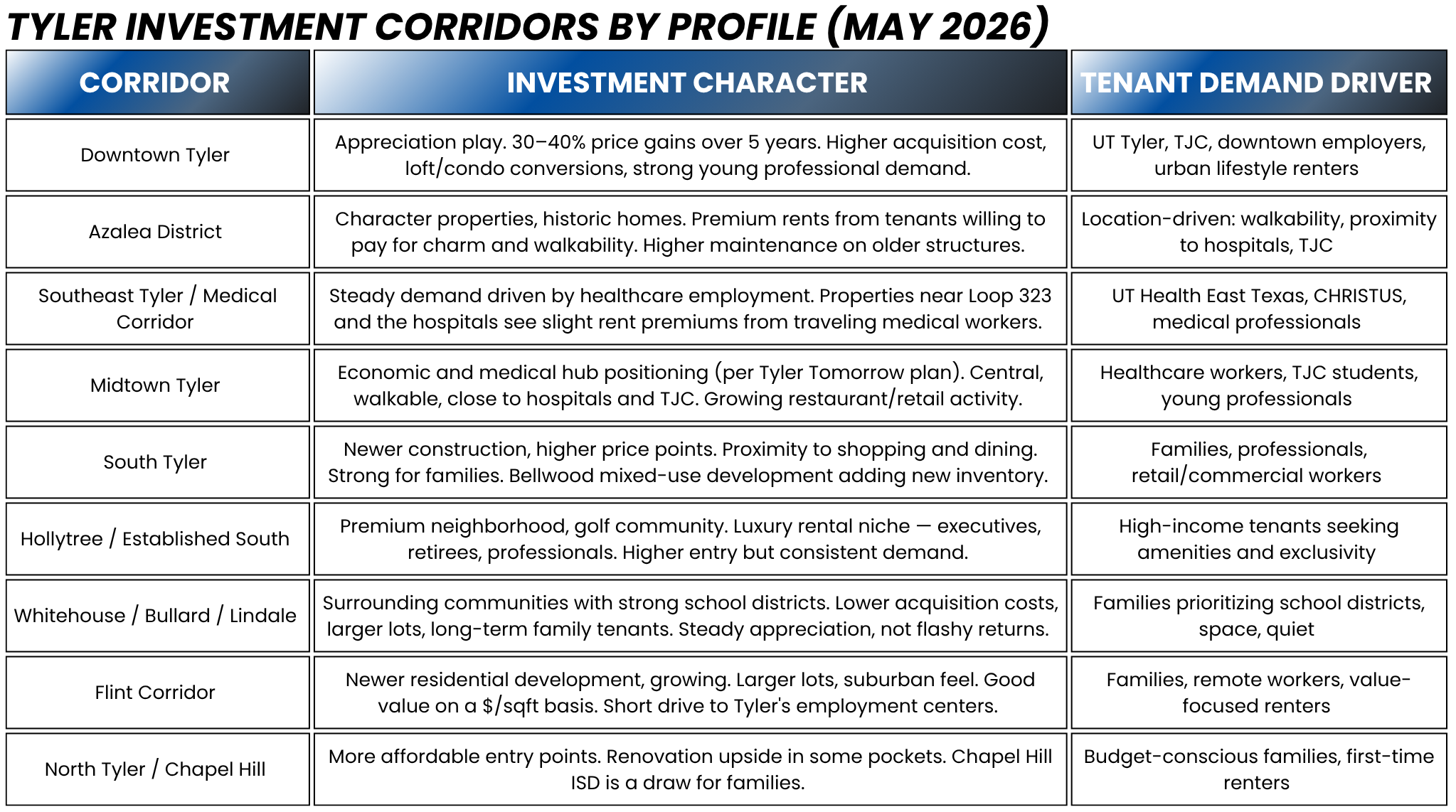
Sources: HomeSmart Stars (https://www.todayseasttexas.com/blog/best-tyler-neighborhoods-investment-properties-2026/) | Crutcher & Hartley – Top Investment Areas (https://dougandpj.com/blog/top-real-estate-investment-areas-in-tyler-tx) | Azalea Mortgage – May 2026 (https://www.azaleamortgage.com/post/tyler-tx-housing-market-may-2026) | Conquest PM – Neighborhoods (https://www.conquestrentals.com/top-neighborhoods-near-tyler-for-renters-who-want-more-space-and-peace-of-mind/)
The corridor you choose depends on your strategy. Cash-flow investors buying in the $150K–$250K range will find the most options in the surrounding communities and North/East Tyler. Value-add investors with renovation capacity can find deals in South Tyler under $150K that rent for $1,200–$1,500 after updates. Appreciation-focused investors look to downtown and the Azalea District. And those targeting the luxury niche focus on Hollytree and Cascades.
Source: HomeSmart Stars (https://www.todayseasttexas.com/blog/best-tyler-neighborhoods-investment-properties-2026/)
Cintra Realty Group manages properties across all of these corridors — from Tyler proper to Flint, Bullard, Whitehouse, Lindale, Longview, and beyond. We can help you evaluate a specific property against the demand profile of its neighborhood.
Question 4: What Will Eat Your Returns?
Two cost pressures are hitting Tyler landlords this year, and both are worse for owners who aren't actively managing them:
Insurance. Landlord insurance premiums across East Texas have jumped significantly — driven by statewide storm claims and rising reinsurance costs. Owners who haven't shopped their policies could be overpaying by 20–30%, or carrying coverage with a deductible that changed without their awareness.
Property taxes. Smith County appraisals came out in April 2026. At approximately 1.25%, even a modest increase compounds quickly — and it compounds every year you don't protest.
Source: Conquest Property Management – Tyler Rental Market Update, May 2026 (https://www.conquestrentals.com/tyler-rental-market-update-what-property-owners-need-to-know-this-summer/)
And a third factor that applies across the board: new apartment construction is adding competitive inventory, particularly along South Broadway. The Landmark @31 project broke ground May 7, 2026. That additional supply puts pressure on older apartment-style units — but single-family rentals in good neighborhoods and school zones remain tight.
Source: Azalea Mortgage – May 2026 (https://www.azaleamortgage.com/post/tyler-tx-housing-market-may-2026)
If you're buying, build all three of these into your underwriting at current 2026 levels.
Question 5: What's the 10-Year Story?
Short-term conditions matter, but rental property is a long game. Here's what supports Tyler's trajectory over the next decade:
Employment is outperforming the state. Dr. Ray Perryman reported in January 2026 that Tyler's job market held steady while Texas as a whole shed 10,000–12,000 jobs since May 2025. The region is projected to add approximately 12,000 new jobs per year over the next five years, with health services leading growth.
Sources: CBS19 – Tyler Job Stability, Jan 2026 (https://www.cbs19.tv/article/news/local/tyler-shines-in-job-stability-as-texas-faces-economic-pressures-says-dr-ray-perryman/501-3e520cae-6d07-46ec-a1d8-7351c06b3ba4) | KETK – Economic Outlook 2026 (https://www.ketk.com/news/local-news/east-texas-economic-outlook-for-2026-predicting-an-increase-in-jobs-across/)
Tyler Tomorrow. The 20-year comprehensive plan adopted March 25, 2026 guides land use, housing, transportation, and infrastructure through 2045. The plan explicitly supports "missing middle" housing (townhomes, duplexes, small multifamily) and adopted three targeted area development plans for Midtown, UT Tyler, and the North End. Infrastructure improvements won't stay contained — they ripple into surrounding corridors.
Source: KLTV – Tyler Tomorrow (https://www.kltv.com/2026/03/26/tyler-city-council-adopts-tyler-tomorrow-comprehensive-plan-setting-20-year-vision-growth/)
Population continues growing. Tyler adds roughly 1,000 new residents per year. Smith County has climbed to approximately 115,000. The in-migration from DFW shows no sign of slowing.
Source: Tyler House Hunters – Spring 2026 (https://www.tylerhousehunters.com/blog/tyler-tx-real-estate-market-update-spring-2026/)
New Texas landlord laws favor prepared owners. Senate Bill 38 (effective January 1, 2026) streamlined eviction but raised the bar for documentation. Owners with clean lease files and professional management systems benefit. Owners without them face delays and complications.
Source: Rental Awareness – Texas Landlord Laws 2026 (https://rentalawareness.com/landlord-laws-in-texas/)
The Bottom Line
Tyler isn't a "hot tip" — it's a thesis backed by local economics. The tenant demand is driven by healthcare employment, school district quality, and affordability pressure from metros. The market conditions in May 2026 favor buyers. And the long-term trajectory — job growth, infrastructure investment, population gains, and a 20-year plan now guiding decisions — supports the hold.
The right question isn't "should I invest in Tyler?" It's "which corridor matches my strategy, and am I set up to manage the investment properly once I own it?"
Cintra Realty Group provides property management, real estate brokerage, and investment services across Tyler and East Texas. If you're evaluating a potential acquisition or want to understand how your current property is performing, our team can help.
Learn about our investment services: https://www.cintrarealty.com/our-services/investments/
Explore our brokerage services: https://www.cintrarealty.com/our-services/real-estate-brokerage/
Access the Owner Portal:span data-contrast="auto" lang="EN-US" style="-webkit-user-drag: none; -webkit-tap-highlight-color: transparent; margin: 0px;