
Fair housing law isn't a suggestion. It's a legal framework that governs every rental transaction in Tyler — from the words in your listing ad to the questions on your application to how you treat tenants after they move in.
Most property owners aren't trying to discriminate. Most tenants aren't looking for a fight. But fair housing violations often happen through ignorance, not intent — a casually worded listing, an inconsistent screening decision, a policy that affects one group more than others without anyone realizing it.
This blog covers what both sides need to know. It's not legal advice (consult an attorney for specific situations), but it's the foundation every Tyler renter and property owner should have.
The Law: Federal + Texas
Two laws work together:
The Federal Fair Housing Act (42 U.S. Code Chapter 45, originally part of the Civil Rights Act of 1968, amended in 1974 and 1988) prohibits discrimination in the sale, rental, and financing of housing based on seven protected classes.
The Texas Fair Housing Act (Texas Property Code Chapter 301) mirrors the federal law and adds protections against discrimination based on protective hairstyles — such as braids, twists, and locs.
Sources: Texas State Law Library – Housing Discrimination
(https://guides.sll.texas.gov/landlord-tenant-law/housing-discrimination) | Texas Property Code Chapter 301 | Key Renter San Antonio – Texas Fair Housing Act, May 2026 (https://www.keyrentersanantonio.com/texas-fair-housing-act)
The Seven Protected Classes
Under both federal and Texas law, it is illegal to discriminate in any housing-related activity based on:
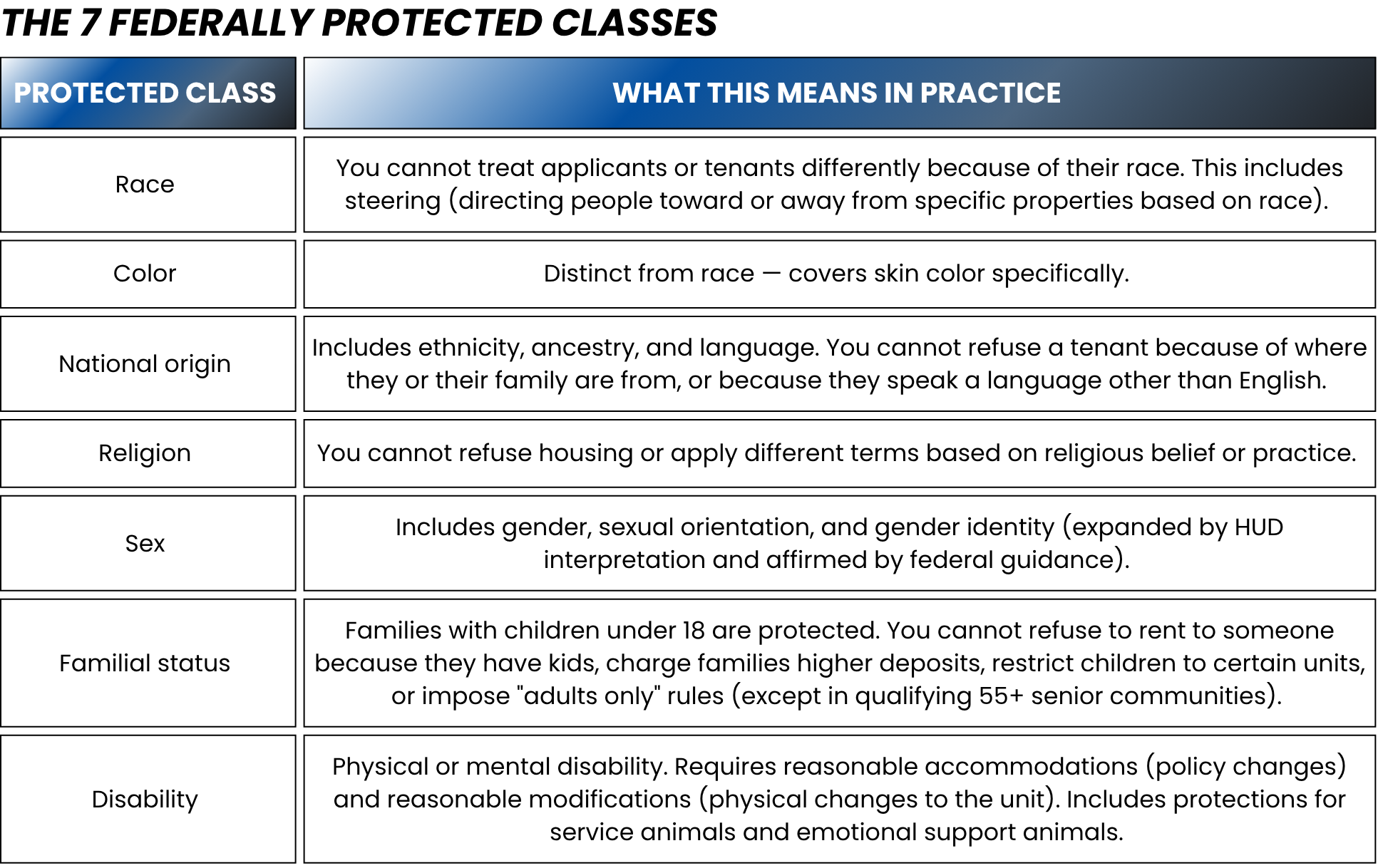
Sources: Texas Fair Housing – TSAHC (https://www.tsahc.org/homebuyers-renters/fair housing) | Texas Law Help – Housing Discrimination
(https://texaslawhelp.org/article/housing-discrimination-in-texas-renters-and homebuyers) | Tenant-Rights.com – Texas Protected Classes, March 2026 (https://tenant rights.com/texas/texas-fair-housing-protected-classes-explained)
What Texas does NOT add beyond federal law: Unlike some states, Texas has not added sexual orientation, gender identity, or source of income (such as housing vouchers) as state-level protected classes. However, HUD interprets the federal "sex" category to include sexual orientation and gender identity. Some Texas cities (Austin, Dallas, Fort Worth, San Antonio) have added local protections. Tyler does not currently have a local fair housing ordinance beyond state and federal law.
One important note on source of income: While Texas law does not prohibit landlords from declining tenants who pay with housing vouchers, HOAs in Texas cannot stop landlords from renting to tenants who pay with public or private housing assistance.
Source: Texas Law Help (https://texaslawhelp.org/article/housing-discrimination-in-texas renters-and-homebuyers)
For Tenants: Know What Discrimination Looks Like
Discrimination isn't always someone saying "we don't rent to your kind." It's often subtle, and recognizing it protects you:
In advertising:
→ A listing that says "perfect for young professionals" (discourages families — familial status)
→ "Quiet building, no children" (familial status)
→ "Christian community" or "near [specific religious institution] — great for members" (religion)
→ "Must speak English fluently" when it's not a job requirement (national origin)
In screening:
→ Requiring a higher deposit from a family with children than from a couple without → Asking whether you have a disability or what medications you take
→ Denying your application because you have a service animal or ESA with proper documentation
→ Running a credit check on you but not on another applicant of a different race
In tenancy:
→ Enforcing noise rules differently for families with children than for tenants without → Restricting children from common areas (pool, playground, laundry room) → Refusing to make reasonable accommodations for a disability (reserved parking, grab bars, policy exceptions)
→ Retaliating after you file a fair housing complaint
What to do if you experience discrimination:
You can file a complaint with:
→ Texas Workforce Commission – Civil Rights Division:
https://www.twc.texas.gov/programs/civil-rights/housing-discrimination
→ U.S. Department of Housing and Urban Development (HUD):
https://www.hud.gov/program_offices/fair_housing_equal_opp/online-complaint
→ Call HUD's Fair Housing Hotline: 1-800-669-9777
You have one year from the date of the alleged discrimination to file a federal complaint, and two years to file a lawsuit.
Source: TSAHC – Fair Housing (https://www.tsahc.org/homebuyers-renters/fair-housing)
For Property Owners: The 6 Areas Where Violations Happen
Most fair housing complaints against Tyler landlords don't come from overt bigotry. They come from inconsistency — treating two people differently without a documented, legal reason for the difference. Here's where it happens most:
1. Advertising language.
Your listing cannot express a preference for or against any protected class. "Great for retirees" suggests a preference against families. "Family-friendly neighborhood" is fine — it describes the area, not who you want to rent to. When in doubt, describe the property, not the tenant you're looking for.
2. Screening criteria.
Your screening standards (credit score minimum, income requirement, rental history, criminal background) must be applied identically to every applicant. If you require 3× income for one applicant, you require it for all. If you run a credit check on one, you run it on all. Inconsistency is the #1 trigger for discrimination complaints.
Under SB 38 (effective January 2026), Texas landlords must disclose their selection criteria to applicants (Texas Property Code §92.3515). This actually helps you — a written, objective screening policy that's applied consistently is your strongest defense against a fair housing claim.
Source: Rental Awareness – Texas Landlord Laws 2026
(https://rentalawareness.com/landlord-laws-in-texas/)
3. Familial status.
You cannot refuse to rent to families with children, charge them higher deposits, restrict which units they can occupy based on having children, or impose rules that disproportionately affect families (like "no noise after 6 PM" that effectively penalizes households with small kids). The only exception: qualifying 55+ senior housing communities.
4. Disability accommodations.
Landlords must make reasonable accommodations (changes to rules or policies) and
allow reasonable modifications (physical changes to the unit, at the tenant's expense) for tenants with disabilities. Common examples:
→ Allowing a service animal or ESA in a no-pet property (reasonable accommodation) → Reserving a closer parking spot for a tenant with mobility limitations (reasonable accommodation)
→ Allowing a tenant to install grab bars in the bathroom (reasonable modification — tenant pays, landlord cannot refuse if the tenant agrees to restore on move-out) → Waiving a "no waterbed" policy for a tenant whose disability requires a specific mattress type (reasonable accommodation)
You cannot charge pet deposits or pet rent for service animals or ESAs. You can hold the tenant responsible for damage the animal causes.
Source: HUD – Assistance Animals
(https://www.hud.gov/program_offices/fair_housing_equal_opp/assistance_animals)
5. Steering.
Steering is directing a prospective tenant toward or away from a specific property or neighborhood based on their membership in a protected class. "I think you'd be more comfortable in our other property" — said to a family, a person of color, or a person with a disability — is steering, even if you believe you're being helpful.
Show all available properties to all applicants. Let them choose.
6. Retaliation.
A tenant who files a fair housing complaint, cooperates with an investigation, or exercises their fair housing rights is protected from retaliation. You cannot raise their rent, decrease services, file for eviction, or take any adverse action because of a complaint. Retaliation claims are separate from the original discrimination claim — and they're often easier to prove.
How Cintra Handles Fair Housing Compliance
Fair housing compliance isn't a checkbox we fill once a year. It's built into how we operate daily:
→ Standardized screening criteria applied identically to every applicant, documented in writing, and disclosed per Texas Property Code §92.3515
→ Advertising review — every listing is written to describe the property, not the ideal
tenant
→ Accommodation protocols — documented process for handling disability accommodation and ESA/service animal requests
→ Training — our team is trained on federal and Texas fair housing requirements
→ Documentation — every screening decision, every accommodation request, and every policy exception is documented. Under SB 38, that documentation is what protects both the tenant and the owner.
We treat every applicant and every tenant the same — because that's the law, and because it's the right way to run a property management operation.
This blog is for educational purposes and does not constitute legal advice. For specific fair housing questions, consult a licensed Texas attorney or contact HUD directly.
Browse available rentals: https://cintra.appfolio.com/listings/listingsLearn about our services: https://www.cintrarealty.com/our-services/property management/
Contact us: https://www.cintrarealty.com/contact-us
Call: 903-705-1000