
These are the questions Texas renters type into Google more than almost anything else. And the answers aren't always what you expect — because Texas is a landlord-friendly state with fewer renter protections than places like California or New York. That doesn't mean you're without rights. It means you need to know exactly what those rights are.
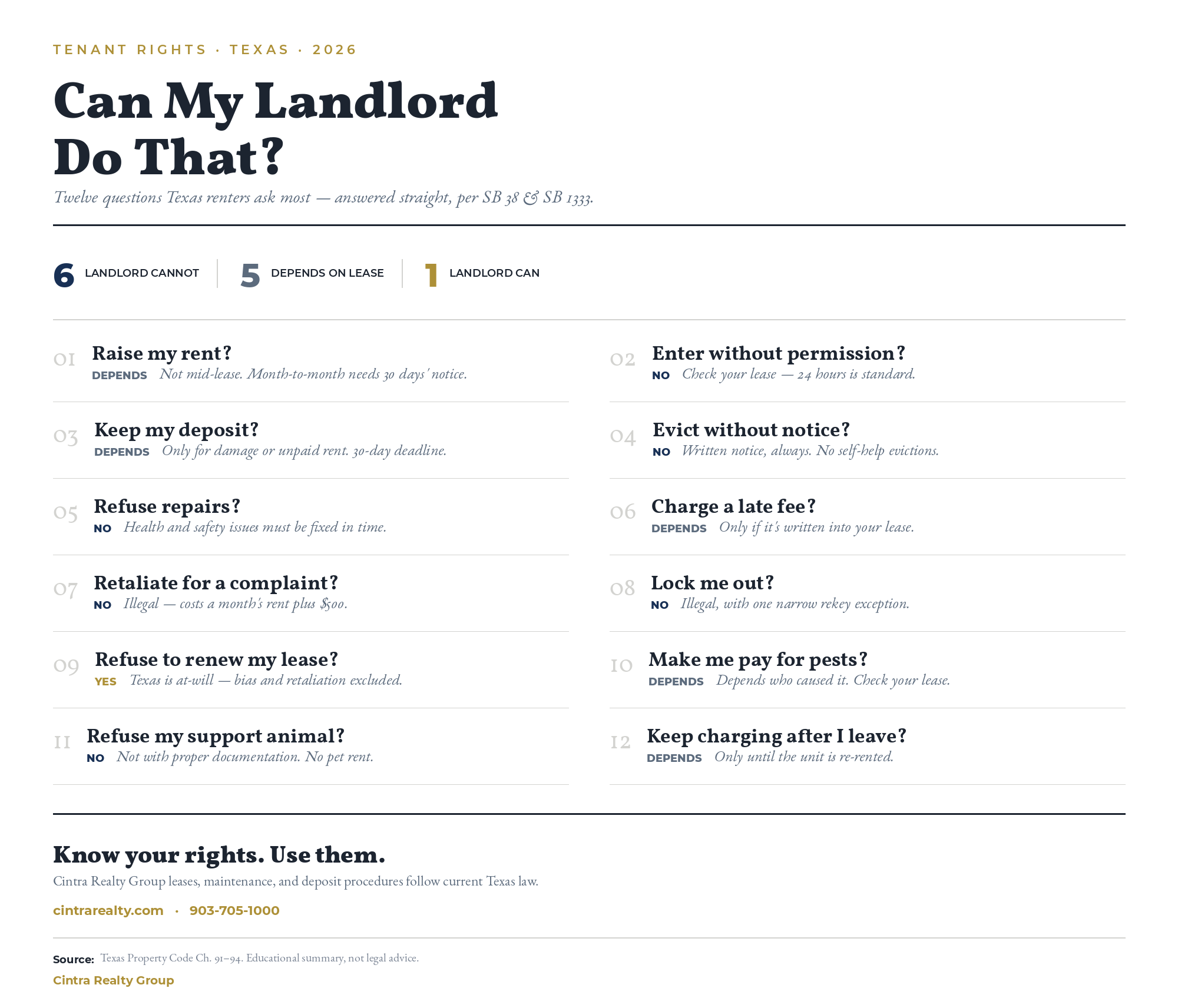
Sources: Texas Property Code Chapters 91–94 | Texas State Law Library – Landlord/Tenant Law (https://guides.sll.texas.gov/landlord-tenant-law/rent) | Hemlane – Texas Tenant-Landlord Laws 2026 (https://www.hemlane.com/resources/texas-tenant-landlord-law/) | Rental Awareness – Texas Landlord Laws 2026 (https://rentalawareness.com/landlord-laws-in-texas/) | iPropertyManagement – Texas Landlord Tenant Rights 2026 (https://ipropertymanagement.com/laws/texas-landlord-tenant-rights)
Here are 12 of the most common "can my landlord..." questions, answered in plain language based on the Texas Property Code, updated for 2026 — including the changes from Senate Bills 38 and 1333 that took effect January 1.
1. "Can my landlord raise my rent?"
Yes — but with rules.
Texas has no rent control. Your landlord can raise rent to any amount. However:
→ During a fixed-term lease (12-month, etc.): rent cannot be increased until the lease expires and a new one is signed, unless your lease specifically includes a mid-term increase clause.
→ On a month-to-month agreement: the landlord must give at least 30 days' written notice before raising rent.
→ A rent increase cannot be retaliatory. If you filed a repair request or reported a code violation and your landlord responds with a rent hike, that's illegal retaliation under Texas Property Code §92.331.
2. "Can my landlord enter my apartment without permission?"
Not freely — but Texas law is less specific than other states.
Texas doesn't have a statute requiring a specific number of hours or days of advance notice for non-emergency entry. However, your right to "quiet enjoyment" of the property is protected. In practice:
→ Most leases specify a notice period (commonly 24–48 hours) for non-emergency access.
→ Landlords can enter without notice in genuine emergencies (fire, gas leak, burst pipe).
→ Unauthorized or repeated entry without notice or consent can violate your right to quiet enjoyment and may give you legal grounds for action.
Check your lease. The notice period is usually defined there. If it's not, 24 hours is considered reasonable.
3. "Can my landlord keep my security deposit?"
Only for specific, documented reasons — and they have 30 days to return it.
Texas law requires your landlord to return your security deposit within 30 days of move-out. If they withhold any portion, they must provide a written, itemized list of deductions.
Allowable deductions include:
→ Unpaid rent
→ Physical damage beyond normal wear and tear
→ Expenses caused by lease violations
→ Other charges specifically listed in the lease
Normal wear and tear is NOT deductible. Faded paint, minor carpet wear from regular use, small nail holes — these are expected and cannot be charged to you.
If a landlord fails to return the deposit or provide an itemized statement within 30 days, a court can award you up to three times the wrongfully withheld amount plus attorney's fees (Texas Property Code §92.109).
4. "Can my landlord evict me without notice?"
No. Written notice is always required before filing for eviction.
The type of notice depends on the situation:
→ Nonpayment of rent: 3-day notice to vacate (pay or leave)
→ Lease violation: 3-day notice to vacate (though some leases allow a cure period)
→ Month-to-month / no lease: 30-day notice to terminate
→ First-time late payment (new in 2026): Tenant gets 72 hours to pay after missing the due date before eviction proceedings can begin
Senate Bill 38, effective January 1, 2026, restructured the eviction process. Courts now focus more narrowly on possession rights, and cases can be rejected if the notice wasn't delivered properly, the rent ledger is inaccurate, or the lease file is incomplete.
Self-help evictions are illegal in Texas. Your landlord cannot change the locks, remove your belongings, shut off utilities, or physically remove you. All evictions must go through the court system.
5. "Can my landlord refuse to make repairs?"
Not if the issue affects health or safety.
Texas Property Code §92.052 requires landlords to make a diligent effort to repair conditions that materially affect the physical health or safety of an ordinary tenant — if the tenant provides written notice.
Here's how the timeline works:
→ You send written notice of the needed repair (keep a copy).
→ The landlord has a "reasonable time" to respond — generally interpreted as 7 days for standard issues, 3 days for health/safety emergencies.
→ If the landlord doesn't repair within a reasonable time, you have several potential remedies: repair and deduct the cost from rent, terminate the lease, or file suit.
Important: You cannot withhold rent simply because a repair hasn't been made — that's not how the Texas statute works. The remedy is repair-and-deduct or lease termination after proper notice, not rent withholding
At Cintra, emergency work orders are handled immediately and all others within 48 hours. We don't wait for the legal deadline to act.
6. "Can my landlord charge me a late fee?"
Yes — but only if it's in the lease and it's "reasonable."
Texas law allows landlords to collect a late fee if any portion of rent remains unpaid more than two full days after the due date. To collect this fee, the landlord must have included notice of the fee amount in the written lease.
Texas doesn't set a specific statewide cap on late fees, but courts evaluate whether a fee is "reasonable." The general standard:
→ 10% of monthly rent for properties with 4 or fewer units
→ No statutory cap for larger properties, but fees must still be reasonable
If your lease doesn't mention late fees, your landlord cannot charge them — even if rent is late.
7. "Can my landlord retaliate against me for complaining?"
No. Texas has explicit anti-retaliation protections.
Under Texas Property Code §92.331, a landlord cannot retaliate against a tenant who:
→ Reports a code violation to a government agency in good faith
→ Requests a repair or exercises a remedy under the property code
→ Participates in a tenant organization
Retaliation includes filing an eviction, raising rent, decreasing services, or threatening any of these actions. If a court finds retaliation occurred, you may be awarded one month's rent plus $500 in damages, plus attorney's fees.
8. "Can my landlord lock me out?"
Absolutely not — with one narrow exception.
Lockouts are illegal in Texas as a general eviction tool. However, Texas has a unique statute (§92.0081) that allows landlords to change door locks if rent is overdue — but only if the lease includes this provision AND the landlord provides the tenant access to a new key 24 hours a day through a secure method (like a lockbox).
Even then, the landlord must leave written notice on the door explaining how to get the new key. And this cannot be used as a substitute for the formal eviction process.
If your landlord changes the locks without following these specific rules, you can recover actual damages, one month's rent or $500 (whichever is greater), reasonable attorney's fees, and a court order to regain entry.
9. "Can my landlord refuse to renew my lease?"
Yes — unless it's for a discriminatory or retaliatory reason.
Texas is an at-will state for lease renewals. When your lease expires, your landlord has no obligation to offer a renewal. They can let it expire, offer new terms, or decline to continue the tenancy.
The two exceptions:
→ Discrimination: Refusing to renew based on race, color, national origin, religion, sex, familial status, or disability violates the Fair Housing Act.
→ Retaliation: Refusing to renew because you filed a complaint or requested a repair violates Texas Property Code §92.331.
If you're on good terms with your landlord and your lease is expiring, ask about renewal 60–90 days in advance. Don't wait until the last month.
10. "Can my landlord make me pay for pest control?"
It depends on who caused the issue.
Landlords are generally responsible for maintaining habitable conditions — and pest infestations that affect health and safety fall under that umbrella. However, if the infestation was caused by the tenant's actions (poor housekeeping, leaving food out, failing to report an issue), the landlord may have a case for charging the tenant.
Check your lease. Many leases in Tyler assign routine pest control costs to the tenant and structural infestations to the landlord. The specific language in your agreement matters.
11. "Can my landlord refuse my emotional support animal?"
Not if you have proper documentation.
Under the federal Fair Housing Act, landlords must make reasonable accommodations for tenants with disabilities — including allowing emotional support animals (ESAs) even in no-pet properties. The key requirements:
→ You have a disability as defined by the FHA
→ You have documentation from a licensed healthcare provider confirming the need for the ESA
→ The ESA provides disability-related emotional support
Landlords cannot charge pet deposits or pet rent for ESAs. They can hold you responsible for any damage the animal causes.
This is separate from service animals under the ADA, which have even broader protections.
12. "Can my landlord keep charging me after I move out?"
Only for legitimate lease obligations — and with limits.